
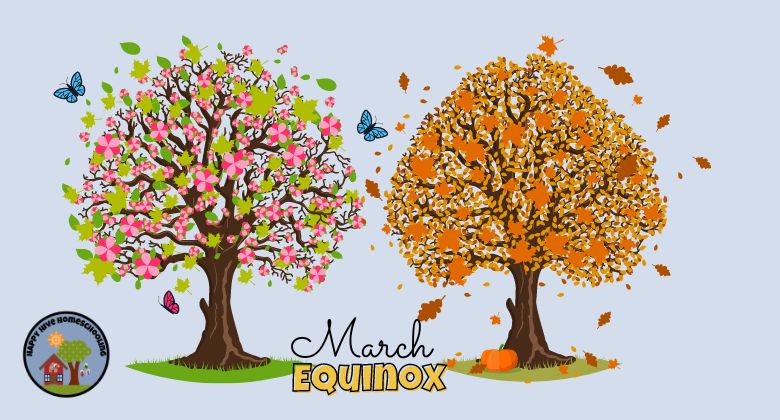
MARCH EQUINOX
This post, the March Equinox, may contain affiliate links, which means Happy Hive Homeschooling may receive a commission, at no extra cost to you, if you make a purchase through a link. Please see our full disclosure for further information.
Celebrating Equilibrium and Transformation: The March Equinox
As March approaches, we anticipate the celestial spectacle known as the March Equinox, a pivotal moment in Earth’s orbit that marks the transition between seasons. Much like its September counterpart, the March Equinox brings a harmonious balance between day and night, signaling the onset of a new phase in the natural world.
Exploring the Significance of the March Equinox
The March Equinox, also referred to as the vernal equinox in the Northern Hemisphere and the autumnal equinox in the Southern Hemisphere, typically occurs around March 20th or 21st. This astronomical event signifies the sun crossing the celestial equator, resulting in nearly equal durations of daylight and darkness worldwide.
Equinoxes vs. Solstices
A Brief Recap Before delving into the March Equinox, it’s crucial to differentiate between equinoxes and solstices. Equinoxes, occurring twice a year, herald moments of equilibrium with equal day and night. Solstices, on the other hand, represent the extremes of daylight length during the year. Accurate labeling with the respective months helps avoid confusion between the Northern and Southern Hemispheres, where seasons are inverted.
March Equinox-Transition in Both Hemispheres
Northern Hemisphere (Vernal Equinox)
In the Northern Hemisphere, the March Equinox marks the arrival of spring. As the sun’s angle increases, temperatures begin to rise, flowers bloom, and nature undergoes a revitalization. Days lengthen, and the transition from winter to spring is characterized by a burst of life and energy.
Southern Hemisphere (Autumnal Equinox)
Conversely, in the Southern Hemisphere, the March Equinox ushers in the fall season. The angle of the sun decreases, temperatures gradually cool, and nature prepares for the upcoming winter. Daylight hours shorten, and the transition from warmer months to cooler ones is marked by a sense of slowing down and preparation.
Engaging Equinox Activities for Kids
- Sun Dial Creation: Build a simple sundial to observe and track the changing position of the sun throughout the day.
- Equinox Artwork: Encourage children to create artwork depicting the balance between day and night during the equinox, using various art supplies.
- Nature Scavenger Hunt: Organize a nature scavenger hunt to explore and observe signs of either spring (Northern Hemisphere) or autumn (Southern Hemisphere).
- Equinox-themed Snack: Prepare a snack using ingredients that symbolize the transition, incorporating elements representing both light and dark.
- Daylight Comparison: Chart the sunrise and sunset times on the day of the equinox, comparing them with other days to highlight the evolving lengths of daylight.
The March Equinox serves as a remarkable juncture, bridging the gap between seasons and inviting us to revel in the beauty of equilibrium and transformation. Through engaging activities and outdoor exploration, children can deepen their connection with the Earth’s natural rhythms, fostering a profound appreciation for the interconnectedness of our planet and the wonders of changing seasons.
Can’t celebrate this year – Mark your calendar & save this holiday for next year!
You can also pin the image below to your Pinterest boards to save this fantastic holiday!

Return to main calendar HERE
Want Ideas for celebrating in your inbox every day? Sign up for our Holiday of the Day newsletter and get everything you need for easy Holiday Celebrations!